


Spinal Anatomy
A thorough understanding of the Normal Human Anatomy is essential for the practicing Chiropractor. One of the main differences academically between Chiropractic school and Medical school, is where Medical school has a major focus on pharmaceuticals, Chiropractic school spends much time on Human Anatomy.
As you recall from Module 3, the Human Spine is made up of individual components known as Vertebrae. There are a total of 24 Human Vertebrae in the Spinal Column. The top 7 vertebrae form the Cervical Spine. The next region, the Thoracic Spine, is made up of 12 Vertebrae and the low back region, the Lumbar Spine is made up 5 vertebrae. Occasionally, there may be more or less Cervical/Lumbar vertebrae, referred to as Anomalies. Anomalies can be a source of back pain.
Under the Lumbar spine is the foundation, known as the Sacral portion of the Spinal Column. The Sacrum, is actually formed from 5 separate vertebrae which eventually fuse together. Finally, under the Sacrum is the tailbone, also known as the Coccyx. Let us look at these various areas more closely.
Without Stabilization from the Spine, the Head & Upper Limbs could not:
· Move Evenly or Smoothly, or
· Support the loads imposed on them
· Protects the Spinal Cord
About 75% of the Spine's Length is contributed by the Vertebral Bodies, with 25% of its length is composed by Intervertebral Disk material.
The spine is composed of the following areas:
7 Cervical Bones
12 Thoracic Bones
5 Lumbar Bones
1 Sacrum
1 Coccyx
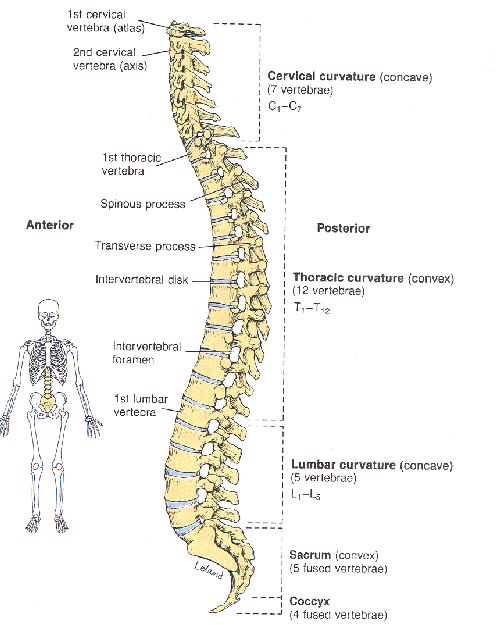
The Spine has 6 Ranges of Motion, which have been discussed in a previous Module.
Vertebrae: This is the name of the individual bones of the spinal column. The basic components of the Typical Vertebrae include the following:
Vertebral Arch - This arch protects the Spinal Column and can be divided into 2 sections:
· The part closest to the Vertebral Body is known as the Pedicle;
· The parts Distal to the Pedicle are called Lamina.
Spinous Process. The 2 Lamina unite to form this portion of the vertebra. The Spinous Processes are what is felt when you run your hand over the midline portion of the Spinal Column.
Transverse Process. These areas are located on the lateral portions of the vertebrae.
Vertebral Foramen. This is where the Spinal Cord, a portion of the Nervous System, passes throughout the Spinal Column, ending in the upper region of the Low Back.
Superior & Inferior Articular Processes. When the bones of the Spine are stacked upon one another, the Superior Articular Process of 1 Vertebrae combines with the Inferior Articular Process of the bone above to form an Articulation / Joint.
These are the basic components of all Vertebrae. As you travel from the Cervical to Lumbar regions, the Bones and their Components increase in Size.
In addition to these Typical Vertebrae, there are a few bones of the Spine which are termed Atypical Vertebrae. These include:
· C1=Atlas
· C2=Axis
· C7=Vertebral Prominens, due to its long Spinous Process.
Further, the Thoracic Vertebrae have Articular Facets for the Ribs, and the Lumbar Vertebrae have an additional portion, known as the Mammory Processes.
Posterior

Anterior