


Cutting Thru the Hype
Over the years, Chiropractic Treatment has been directed at "relieving" the problems created by the subluxation, a chiropractor's "primary lesion". However, much confusion and discussion has been created over the use of the term subluxation. As defined earlier, the strict definition of a Subluxation, is used today to describe what is referred to as a Medical Subluxation, an articular lesion that is less than both a Luxation and a Dislocation.
The Subluxation Complex is a Theoretical Model of motion segment dysfunction (Subluxation) that incorporates the complex interactions of pathologic changes in nerve, muscle, ligamentous, vascular, and connective tissues. This "Complex" was first described by Dr. L. John Faye, D.C. (#1 p. 147) as a paradigm shift from the static misalignment or "bone out of place" concept of subluxation. The vertebral subluxation complex has served as a more dynamic and inclusive teaching and research model for the chiropractic profession. This change in paradigm, while providing a concise explanation for this complex, also began a shift in the profession so that the scientific community would be more open to the Chiropractic profession as a whole.
Supporting Palmer's concept that the neurologic component of the subluxation is the cornerstone of Chiropractic theory, the subluxation complex provides a structure for better understanding the foundation principles of Chiropractic theory and provides a paradigm for Chiropractic education and research.
Let's begin by looking at various levels of the term "Subluxation":
Subluxation - a motion segment in which alignment, movement integrity and/or physiologic function are altered, although contact between the joint surfaces remains intact.
Manipulable Subluxation - a subluxation in which altered alignment, movement, or function can be improved by manual thrust procedures. (Compare this to the Medical definition of a subluxation, where joint integrity has been altered, and manipulation is most likely contra-indicated).
Subluxation Complex - a theoretical model of motion segment dysfunction (subluxation) that incorporates the complex interaction of pathologic changes in nerve, muscle, ligamentous, vascular and connective tissue.
Subluxation Syndrome - an aggregate of signs and symptoms that relate to pathophysiology or dysfunction of spinal and pelvic motion segments, or to peripheral joints.
The development of the Vertebral Subluxation Complex (VSC) is distinctively Chiropractic and reflects in a unique way the clinical practice of Chiropractic. Common to all concepts of Subluxation are some form of kinesiologic dysfunction and some form of neurologic involvement. By using the term "kinesiologic", reference is being made to the concept of motion. The primary form of kinesiopathology that is addressed in chiropractic clinical practice is Hypomobility, often referred to as a Fixation.
The original concept of the VSC outlined by Faye in the 1980's contained 5 components:
1. Kinesiopathology
2. Neuropathology
3. Myopathology
4. Histopathology
5. Biochemical abnormalities
Since then, this theory has been revised and expanded. In both versions, the Kinesiopathologic component is listed at the top, because restoration of motion is the central goal in the clincial practice of Chiropractic.
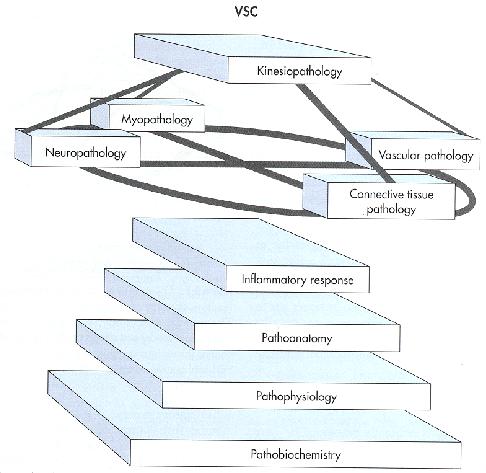
| Original | Revised |
| Kinesiopathology | Kinesiology |
| Neuropathology | Neurology |
| Myopathology | Myology C.T. Physiology Angiology Inflammatory Response |
| Histopathology | Anatomy Physiology |
| Biochemical Abnormalities | Biochemistry |
Movement is affected by the muscles (Myologic component); guided, limited, and stabilized by Connective Tissue; and controlled largely by the Nervous System. The Vascular system serves the essential nutritive and cleansing role for all tissues and is the conduit for the immediate stages of the Inflammatory Response (at least in tissues with a blood supply). Each of these components works in coordination with the others to permit and sustain proper movement in the vertebral column. Interference with a single component affects all the other components.
Thus, all the portions which makes up each component can lead to Spinal Pathology if dysfunction occurs: The Intervertebral Discs; the Articular Cartilage, the ligaments associated with the Vertebral Column, would be examples of the Connective Tissue component. Nerve roots, dorsal root ganglia, etc. would be elements of the Neurologic Component, etc.
From a Clinical point of view, the model of the VSC is complete when the following areas are considered:
1. Basic structural-functional level of the VSC model;
2. The Level of Diagnostic evaluation, used to connect all the components listed in the basic model;
3. The Therapeutic Outcomes that represent the outcome of therapeutic intervention.